In the last two weeks prior to the Court Date, The QPS have to get their act together.
They don’t like surprises, so will be at pains to learn what your case is – hence the requirement for the accused to give an outline of their argument prior ‘in the approved form’.
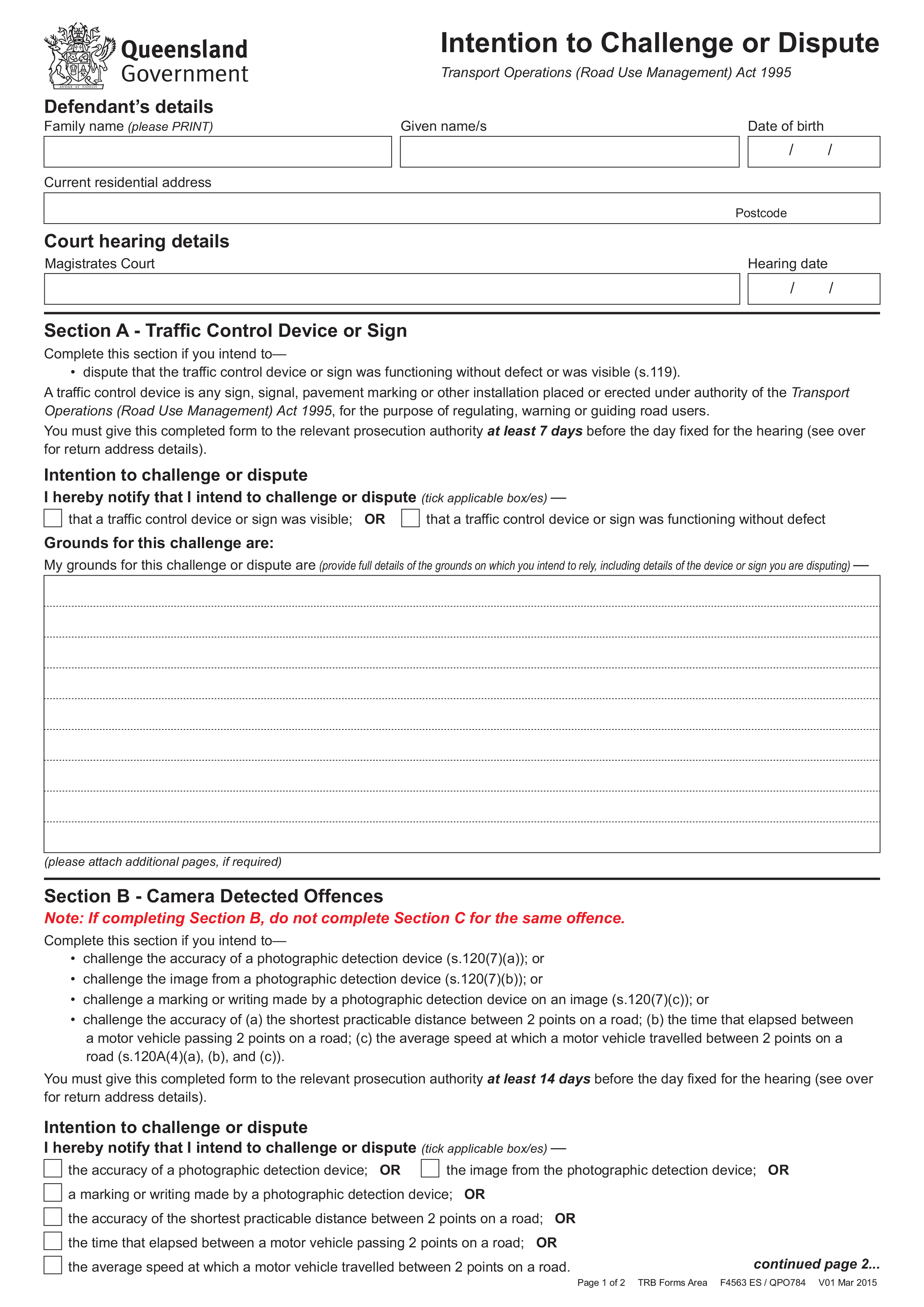
I don’t know what the ‘approved form’ is. It is based on the Form No. TRB Forms Area F4563 ES / QPO084 V01 Mar 2015, which expects you to state your grounds for the challenge. Three Sections are available – pick the relevant one. In my case, it was Section B, ‘Camera Detected Offence’. I ticked all the boxes and added about 300 pages of associated data about rear end fatalities, the Australian Standard for radar, an Auditor General report regarding the speed programme, and the aforementioned Redflex patent information.
I was apparently expected to provide stuff in some form of approved legalese, possibly citing case precedents. I don’t know. Perhaps it would be a good advice to seek some help from Legal Aid or a lawyer well beforehand if you want to get this aspect of your case correct.
Whatever the case, I received an unexpected email to my private email address from the Chief Prosecutor.
He was at pains to get his head around my story, since I had provided a long winded explanation of events as I understood them way back when the Infringement Notice was first issued. I had naively thought that common sense would have prevailed and some leniency shown, but apparently the QPS Policy is to always decline no matter the circumstances. Clearly they have no regard for the provisions of Section 25 of the Criminal Code when applying their ‘policy’..
I had realised when I finally got hold of the video that my reconstruction of events as I had initially surmised was flawed. I had mistakenly thought that 2 vehicles had been behind me – one in each lane – when in fact the video revealed that there had only been one, and it had followed me across into the second lane such that I got two different views of the same vehicle.
The Prosecutor wanted to make a big issue of that, but came to realise that my arguments were sound, and I had simply erred in my assessment as a result of the very short time frame, the poor light at dusk, the fact that my vehicle had privacy glass, and my car interior mirror and side mirror gave two totally different perspectives of the following vehicle (the external side mirror has convex glass to achieve a wider field of view).
So let’s look at the correspondence in more depth.
Prosecutor:
a) confirms receipt of my paperwork
b) states my submission is very lengthy (I got a laugh out of that)
c) outlined the proper procedure as ” the proper process for such a document is to lodge the same with the court, annotate the relevant registry details and serve a copy of the same on the Respondent party. The footer notes to the pages include details of the relevant Uniform Civil Procedure Rules under which the document is formed and includes the details for the deponent including the address for service of reply materials “. I guess that pretty much sums up what the ‘approved form’ is.
d) Because I didn’t follow the correct format, my submission and that of the Police would need to be heard by a Court and await directions issued by the Court.
e) confirmed that the Redflex SR101 does not conform to the Certification requirements of the National Measurement Act
f) stated that the testing componentry used in testing of the device does have Certification under the Measurement Act (I think this is flawed – just because a test instrument is certified does not automatically follow that the device being tested must also be correspondingly accurate – many other factors can come into play).
g) confirmed that the SR101 incorporates a radar component
h) argued that the SR101 is not subject to the provisions of the Australian Standard for radar because it has been described in legislation as a photographic detection device. (Apparently if you call a spade a shovel it ceases to be a dirt removal device in the eyes of the Queensland lawmakers).
i) The precedents regarding operator training that I cited based on aussiespeedingfines information (Grice v Day [2010] Qld District Court 490 have been superseded by more recent decisions, namely:
Clampett v Hales & Anor. [2013] QCA 3
Crabbe v Queensland Police Service [2013] QDC 122
Robinson v RMS [2016] New South Wales District Court 277
Jameson v Police [2016] South Australian Supreme Court 5
Millington v Police [2015] South Australian Supreme Court 52
Agar v Petrov [2015] Victorian Supreme Court 168
Agar v Dolheguy [2010] Victorian Supreme Court 506
j) The precedent advocated by aussiespeedingfines relating to the National Measurement Act is Breedon v Kongras (1996) 16 WAR 66 1. This has been circumvented in Queensland by legislating that a combined red light and speed camera is an approved device for law enforcement purposes. The legislation in Western Australia apparently failed to define the device in question (a Sheridan gauge for measuring fish length) as an approved measuring device for legal purposes.
k) The precedent Grice v Day [2010] regarding the training of the operator has been overturned on appeal at Day v Grice [2011] Qld Court of Appeal 178. (My reading of the appeal however makes me wonder if the Defendant failed to raise certain issues that would have helped him win – one of the dangers of representing yourself I guess).
l) The Prosecutor suggested (correctly) that my submission resembled information widely circulated on the internet, and recommended seeking legal advice.
My Response:
WITHOUT PREJUDICE
Dear Sergeant
Thank you for your communication re the video and other matters.
I have taken the liberty of returning the video with a stop watch overlay embedded into the top left corner to permit a better evaluation of the evidence that can be derived from the video.
I agree that the video exhibits some clear discrepancies from my original construction of what I believed to have occurred, but I hope that the attached information will explain the discrepancy to your satisfaction.
I am reminded of the old saying about the meaning of assume – a false assumption originally on my part certainly led me to a wrong evaluation of what transpired
The attached correspondence should help to address the inconsistency, and the video with stop watch overlay will at least make one of the tasks that I asked of the QPS unnecessary – I plan to use it as a key component in my defence.
As I state in the attached letter, I would prefer this matter to be resolved amicably without need of court proceedings, and remain willing to discuss the matter further if the QPS have that option at their disposal at this stage. I have not seen any evidence of a willingness on the part of the QPS to relent in any way thus far though, so I am not optimistic. My mobile is xxxxxxxxxx.
If you don’t wish to talk, then please proceed with preparing the brief and the evidence that I requested.
Regards etc.
And my attachment consisted of a detailed explanation of the discrepancies between my original letter and the evidence depicted in the video.
Prosecutor:
a) Thank you. I think I understand your view on the matter.
b) Described the procedure in Court
The Queensland Police Service will prepare a brief of evidence for disclosure as per the directions of the court.
If it goes to hearing, my Notice of Intention to Challenge and outline of submissions will be subject of legal argument before the court.
Reminded me that many of my submissions are not supported by law and are rejected by the Queensland Police Service.
c) Reiterated that I should get legal advice and my form of submission erodes its legal effect (but doesn’t eliminate it apparently).
d) He further indicated that the last 3 boxes that I ticked on the Notice of Intention form relate to speed measurement devices that use speed over distance technologies that are not applicable to the device used in my case (Redflex SR101). Again, I think this is a flawed argument – otherwise why does the datablock in the photos specify a distance and a time elapsed?)
e) Claimed that he could not identify exactly what my grounds for objection were based on my submission, and that I had submitted two versions of the event.
f) Gave an incorrect summary of my story and asked what I expected to achieve through all my requests for documentation and witnesses that I had made (and there were lots of them).
My Response:
Dear Sergeant xxx
You have misunderstood my explanation.
I changed lanes to avoid being rammed from behind by the Ford F250, which showed no indication of being able to stop in time. Acceleration was necessary to actually make the lane change, since I was already coasting to a halt and braking behind the LandCruiser when I recognised the danger from behind. The F250 gave no indication in the time that I was able to observe it that the driver intended to change lanes. For all I knew at the time, the driver was distracted, on the phone, on drugs or simply incompetent.
I maintained the acceleration only as long as necessary to maintain a safe distance in front of the F250, which unbeknown to me at the time was also changing lanes. The driver of the F250 must also have been of the opinion that he was uncomfortably close behind me, since the video clearly shows that he was braking for almost the entire duration of the video, even after I had returned to the original Lane 3. ( I was planning to turn right into (the next) Street from Lane 3 enroute to (my destination), which was why I was happy initially to stay in Lane 3 behind the LandCruiser and wait for the path to clear).
The purpose of my request for disclosure of so much information and the witness(es) is to get a sound grasp of the technologies and training involved regarding the Redflex SR-101 and allow a thorough cross examination at a technical level, with the goal being to establish reasonable doubt. I feel that I already have a good grasp of how it works, and will be looking for certain key bits of validating information within the material.
The QPS position expressed in your letter dated (date) would seem to preclude a life threatening situation as being a valid justification for my actions on the day. I quote
“You cannot attribute blame for exceeding the speed limit on other vehicles in the vicinity at the time and your decision to increase speed beyond the speed limit is not conducive to ensuring the safety of yourself, the lives of your passengers and other motorists. Exceeding the speed limit to overtake can exacerbate an already potentially dangerous manoeuvre”
So logic would dictate that my only option is to prove reasonable doubt about the accuracy of the recorded speed. I expect my (technical) background will stand me in good stead in that respect once I am provided the technical and training materials that I am chasing.
My justifications for my action will then become moot unless found guilty, at which point the Magistrate will become the final arbiter of my justifications, not the QPS.
So in the spirit of transparency that you were offering earlier, please provide the technical and training material that I have requested ASAP.
Regards
Prosecutor:
a) Thanked me for my clarification
b) Told me to write to Redflex to get the manuals and technical specifications, since the QPS only operate the equipment – installation, maintenance and calibration is performed by unnamed third parties operating interstate and internationally.
c) Claimed that my submissions did not disclose an excuse at law that he can identify. (I found this particularly interesting in view of a face to face discussion that I subsequently had with him – see later)
d) confirmed his intention to proceed to trial and that the judge will be the final arbiter.
e) invited me to contact him again if I had further questions.
As a Result:
I wrote to Redflex via email and registered mail requesting the technical stuff. The email was ignored, but the registered letter elicited a response:
My Letter to Redflex:
Redflex Holdings Ltd. and Redflex Traffic Systems
31 Market Street,
South Melbourne,
Victoria 3205, Australia
Attention: Mr. M. J. Talbot
Dear Sir,
I am currently in discussion with Sergeant (name) of the Qld Police Service in regard to an alleged traffic infringement that was generated by a Redflex SR101 installation in (town) Queensland.
The device bears the Serial Number ###
Sergeant (name)’s most recent communication has directed me to contact you directly to obtain information pertaining to the device.
Please allow me to view or access the following information as indicated by Sergeant (name) regarding the SR 101 device.
1) the installation and calibration requirements for the SR 101 device located at Qld Police Site Code #### (location)
2) the SR 101 Device Operation and Maintenance manual
3) details of the recommended procedures and the technologies used in evaluating images captured by the Redflex SR 101 device
4) a copy of the training material provided to the Queensland Police Service relating to the operation of the SR 101 and in the evaluation of the images derived therefrom.
5) Details of how the image evaluation procedures and / or software are calibrated and certified to match the physical installation
Other Questions
1) Can you please advise whether the SR 101 device SDC xxxx utilises the technology that is described in US Patent 8712 105 B2 for the secondary speed verification system held by Redflex?
2) Do Redflex Traffic Systems, Redflex Holdings or any of their affiliates or subsidiaries hold status as a Registered Training Organisation (RTO) within Australia, and if so, what is the RTO Number?
3) Is the use of K Band slant radar technology the primary speed measuring device used by the SR 101 in detecting a speed infringement?
4) If yes, does the radar component of the device conform to the requirements of AS 2898 – 2003 Parts 1 and 2?
5) Is the radar component of the device critical to its overall operation for the purpose of measuring the speed of a target vehicle when the traffic light is in the green phase?
6) Is the radar reading derived by the radar componentry then used as a predictor of when the target vehicle will reach a defined starting point to initiate the first photograph?
7) Likewise is the radar reading used to predict when the target vehicle will arrive at the second point where an image is captured? ie at a defined point a set number of metres distant from the initial image capture point? (x metres for Qld Site location #####).
8) If the radar acts as a predictor for when to initiate the 2 images, is it capable of determining the vehicle overhang applicable to the target vehicle (wheel centreline to front or rear of vehicle distance) accurately? And to what degree of accuracy?
9) Can a large stationary vehicle close to the target vehicle lead to a potentially false reading by reflection of the beam as discussed in the Australian Standard Part B Section 2.4.3, which states
“The operator shall ensure that the radar beam is not being reflected away from the direction in which it is being aimed by stationary objects as this may lead to incorrect target identification.
NOTE: Typical stationary reflective objects are advertising hoardings, traffic signs, parked vehicles, metallic fences, sheds and phone boxes.”
10) Is it feasible that for a target vehicle that is accelerating or decelerating rapidly through the area of the beam, the speed may be inaccurately measured as per the following information?
ACCELERATION LIMITS
Police radars are designed to measure vehicles traveling at a relatively
constant speed. Vehicles changing speed greater than radar accuracy during one
sample period cannot be measured, speed is changing too fast.
Acceleration Limit = accuracy /
sample period
amax = ± vacc / ti
amax = Maximum
Acceleration
±vacc = Speed Accuracy
ti = sample time
Common sample periods are 250, 300 and 333 milliseconds, 1/4, 0.3, and 1/3 seconds.
Acceleration Limit
| Sample Period | Change in Speed | |
| seconds | milliseconds | |
| 0.167 | 167 ms | ± 6.0 mph |
| 0.2 | 200 ms | ± 5.0 mph |
| 1/4 | 250 ms | ± 4.0 mph |
| 0.3 | 300 ms | ± 3.3 mph |
| 1/3 | 333 ms | ± 3.0 mph |
| 1/2 | 500 ms | ± 2.0 mph |
| 1 | 1000 ms | ± 1.0 mph |
11) If the above information is accurate, what is the sample period applicable to the SR 101 device with Serial No. #######?
12) Who are the ‘other parties’ described by Sergeant (name) who installed the (Serial No) device and on what date? Likewise for any upgrades or digital conversions performed on the device.
13) Who are the ‘other parties’ described by Sergeant (name) who perform the maintenance and calibration of the said device, and how can they be contacted?
14) can you please identify an employee of your organisation who would be qualified as an expert witness relating to the Redflex SR 101 equipment and image evaluation procedures?
I appreciate that the questions above may impinge on proprietary information and technologies which you may not wish to disclose. However I am quite prepared to sign a non-disclosure agreement relating to any and all information disclosed, with the only proviso that I be given the right to use it in a Queensland Court in my defence submissions.
Thanking you in anticipation,
Yours faithfully
The Response from Redflex:
Dear Sir,
Alleged Traffic Infringement – Request dated (date)
We refer to your letter dated (date), received by us today.
We write to advise that we are the equipment supplier to the Queensland Police Service (QPS). We supply equipment and provide services based on specifications and requirements agreed with and accepted by QPS. Regrettably, we will not be providing responses to your questions at this stage.
Yours sincerely,
Ian Teh
Deputy General Counsel.
Get a Character Reference
It’s not good enough to just rock up, put up a good case, and then lose. The Magistrate will have tried to help you a bit if you look like a decent person, but at the end of the day has to follow the law.
So if you lose and it comes down to sentencing, he will be guided by his impressions of you as a person. In that judgement, you will be assisted if you can present some evidentiary material as to your character that is not of your own making (‘self praise is no recommendation’ goes the motto).
So look to your circle of friends and acquaintances and choose someone with a bit of gravitas within the community. A doctor, priest, a local community leader or the like, In my case, I chose a J.P. of my acquaintance.
Have them write a letter of support that speaks to what a fine upstanding person you are, but does not attempt to speak to your guilt or innocence in the particular matter. There are excellent guidelines on the subject of character references at these links.
https://www.gotocourt.com.au/criminal-law/qld/character-references/
https://www.armstronglegal.com.au/criminal-law/court-preparation/character-reference
 fight the man